Posts

Showing posts with the label #women's writing

Sophie de Tott and Elizabeth Craven

Image
Sophie de Tott by Vigée-Lebrun Of all the emigrés who were welcomed to Brandenburgh House by Elizabeth Craven in the aftermath of the French Revolution, none was more remarkable than Sophie de Tott. She was an artist who exhibited her paintings at the British Royal Academy and when she came to stay at Brandenburgh House she painted portraits of Elizabeth's second husband the Margrave of Anspach and her son Keppel. Madame de Tott had once lived in Paris among the highest French aristocracy. As a girl she had been adopted by a rich Countess and lived in the heart of the capital, meeting all the leading intellectuals and enjoying the most cultivated salons. Laudatory poems had been written about her. She had known Louis XVI, Marie Antoinette, Lafayette, Madame de Stael and Elisabeth Vigée-Lebrun who painted this oval portrait of her in 1786. Since fleeing from Paris in the Revolution of 1789 she had lived in Switzerland and Germany, earning a living with her paintbrush. When...

Elizabeth Craven on Eighteenth Century Poetry website

Image
The Eighteenth Century Poetry website has now got an updated and far more comprehensive entry on Elizabeth Craven.  Elizabeth Craven painted by Romney. © National Portrait Gallery, London It lists some of her most outstanding short poems, lists full-length biographies of her and mentions entries in the DNB and reference works. This is very welcome! https://www.eighteenthcenturypoetry.org/authors/pers00215.shtml

An Autograph Letter of Elizabeth Craven to Louis XVIII of France

Image
One thing that always annoys me is how many letters written by women or appertaining to women are not catalogued under that woman's name in archives, but are shoved in with the papers of a male relative or recipient. The British Library does not list this item in its collection under Elizabeth Craven. It is left hidden in the miscellaneous  correspondence of her son Keppel. Yet this letter is of great interest being written to Prince Louis Stanislas Xavier de Bourbon, known as Count of Provence until in later life he became  King Louis XVIII of France. He was the younger brother of Louis XVI who had been sent to the guillotine in 1792. The letter is dated  in 1814,  just before his accession to the throne after the fall of Napoleon. It indicates what friendly terms  Elizabeth Craven  was on with him during his exile in England, and was sent as a cover-note with a gift of a manuscript by a French author, apparently dedicated to her late husband the Margrav...

Elizabeth Craven (1750-1828) Complete Bibliography

Image
Elizabeth Craven's works are a lot more numerous than usually supposed. She never made a complete list of them in her Memoirs, which is a pity. Very few are mentioned in the DNB entry under her name. This catalogue is regularly updated. Abdoul, a comedy,    printed in  Nouveau Theatre de Societe d'Anspac et de Triesdorf,  ed. Asimont, Volume 2, 1791. The Adventures and Exit of Sir Tristram Fiddle-Faddle. MS tale. c.1793. In FELS, Catholic Institute Paris. An Arcadian Pastoral .  1782. MS in Bodleian Library. Epilogue was printed in The Annual Register, or a View of the history, politicks and literature of 1782 ,  ed.Robert Dodsley, p.200. Also in The Hibernian Magazine, Or, Compendium of Entertaining Knowledge , 1782 p.271. The Castle of Alstein, a Melodrama. Unpublished MS play in three Acts.   c.1793. FELS archive, Catholic Institute, Paris. Diane, or, Repentir des Voeux.    Ballet en un Acte, avex des Arri...

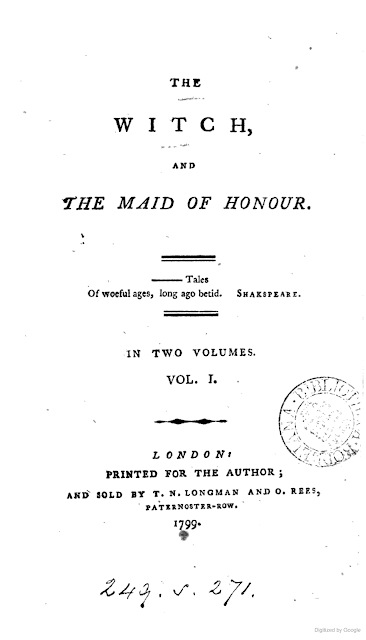
The Witch, and the Maid of Honour: A Lost Novel by Elizabeth Craven

Image
The Witch and the Maid of Honour is a two-volume novel published privately and anonymously in London in 1799. It has a dedication to the Maids of Honour, signed "the Old Woman". To THE MAIDS OF HONOUR. LADIES, The writer of the following trifle requests the honour of presenting to you the History of a Lady who formerly held the same exalted situation that you hold now. Permit Isabella Markham to solicit your patronage for the Author, who has the honour of being,                          With great respect,                                         Your obedient humble Servant,                                                                   ...