Posts

Showing posts with the label #Regency

Anspach Place, Southampton

Image
Why is there a square named Anspach Place in Southampton? It is named after Anspach House, a now-vanished building once occupied by Elizabeth Craven and her second husband, the Margrave of Anspach. She and the Margrave leased a house there on the West Quay from 1801 until 1812 to use as a holiday home. She loved sailing and kept a boat in Southampton harbour, in which she sailed across the Channel on at least one occasion. Southampton attracted many sailing enthusiasts who loved to take their private boats out towards and around the Isle of Wight. Later she also leased the adjacent house, and named the combined residence Anspach House.  It was next door to the mediaeval Westgate, with its stone Gothic arch.  Anspach House 1845 In July 1806, when recently widowed, Craven wrote to her friend Sir Isaac Heard from Southampton, "I visit this Place as the Prettiest and quietest for Sea-Bathing I know." [1]  In the summer of 1809, Craven spent some weeks there with he...

Names in Jane Austen

Image
 The names in Jane Austen's novels may appear bland and commonplace, but are always carefully chosen and often contain coded meanings.    In Pride and Prejudice,  Austen gave the heroine a name, Bennet, that is a close twin of her own.  Austen or Austin is a contraction of "Augustine". Austin-friars in the City of London is a street where before the Reformation there was a monastery of the order of St Augustine, one of many in England. The name Bennet is a contraction of "Benedict" another saint who founded a monastic order. Austen surely chose the name because the heroine, Elizabeth Bennet, is a self-portrait. The Bennet family resemble the Austens in one crucial respect - they cannot pass on the family home to the next generation. Their predicament is due to an entail whereas that of the Austens arose out of the fact that her father was a clergyman whose rectory would pass to the next incumbent.     One of the privileges of the English aristocracy is...

Rape in Regency London

Image
Fitzroy Square London c.1800     We've recently been told that less than 5 per cent of rapes reported in England today lead to prosecution. I n Regency England, it was very different. A man accused of rape could face such severe penalties as the reproach of his wife -- a fearsome deterrent! East Fitzroy Square, London 1807 This case was reported in 1817 as taking place in Fitzroy Square in the heart of Mayfair. The accuser, or "prosecutrix" as she was called in court, was a fourteen-year-old servant girl and the man she accused was her employer, a butcher in Fitzroy Market.      The newspaper report ran:- WEDNESDAY. - Clark, a butcher, in Fitzroy-market, was indicted for a rape on  Leah   Edwards . The prosecutrix deposed, that she is 14 years of age. Her mother resides in Grafton-street, Fitzroy-square, and she herself was servant to the prisoner, who is a married man.      On the night of the 13th of March, the prisoner was from h...

Baron von Aacken, the Waterloo Hero Who Committed Suicide

Image
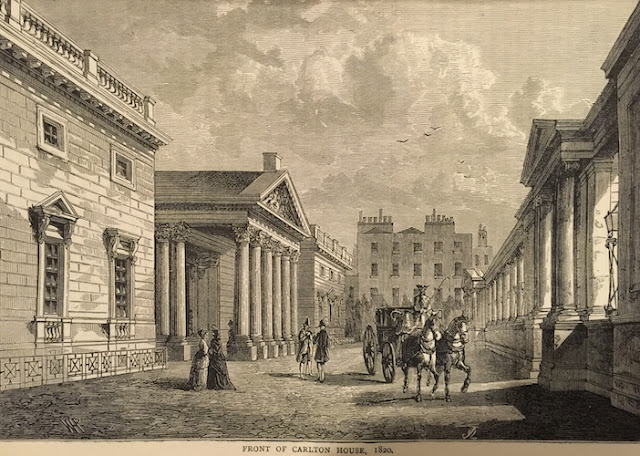
In London in 1817,  two years after the battle of Waterloo, a shocking event took place. A foreign gentleman who had arrived in the country three months earlier, shot himself in the head at the entrance to Carlton House in Pall Mall, the residence of the Prince Regent.       The melancholy background story tells us a lot about the unequal recognition and reward that was offered to the commanders in this allied victory in which British, Prussian, Hanoverian, Bavarian, Belgian, Piedmontese, Sardinians and even some Frenchmen fought side by side against the Imperial forces. The facts were reported in The Gentleman's Magazine a couple of weeks after his death, when a jury at the inquest pronounced a verdict of suicide caused by insanity, and having read various testimonies from his military colleagues, said that von Aacken had played a vital, key role in winning the battle of Waterloo. Without him the allied army would never have regained its position after the...

Who Betrays Elizabeth Bennet? In defence of Charlotte Collins.

Image
     In his book  Who Betrays Elizabeth Bennet?: Further Puzzles in Classic Fiction , Professor John Sutherland raised the question of how the rumour of Elizabeth Bennet's imminent engagement to Mr Darcy could have reached the ears of Lady Catherine de Bourgh, prompting her to make her bossy and interfering call on Elizabeth at Longbourn in volume 3 of Jane Austen's Pride and Prejudice .      I love this sort of criticism, which used to be referred to as the "How many children had Lady Macbeth?" school. Now desperately unfashionable, it treats characters in novels as real people who exist beyond the parameters of the written narrative and can thus be followed and investigated outside the boundaries of the text. It makes an interesting game, and it is certainly far less absurd than many of the currently fashionable schools of criticism. Professor Sutherland is right, that if we cannot provide any reasonable explanation of how and why this rumour travell...

The Children of Apollo - Fame and Infamy in Georgian England

Image
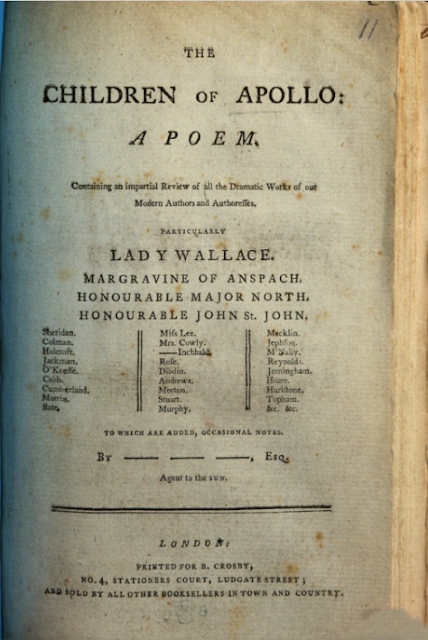
       Throughout her life, Elizabeth Craven was haunted by the scandal deliberately spread by her first husband, Lord Craven, at the time of their separation. It was impossible for any woman to separate from her husband in Georgian England without a tinge of unpleasant scandal, and he went further than most irate husbands, spreading sensational accounts of her behaviour to stir up malicious gossip.      Needless to say, he did not attract any opprobrium for having a mistress, but she f or the rest of her life, struggled to throw off this unfair reputation.     In 1794, when she had re-married and returned to England, a lengthy poem appeared entitled  The Children of Apollo: a Poem. Containing an Impartial Review of all the Dramatic Works of out Modern Authors and Authoresses. Particularly Lady Wallace. Margravine of Anspach. Honourable Major North. Honourable John St. John. Sheridan. Colman. Holcroft. Jackman. O'Keeffe. Coob. Cumberland...

Chawton House, the home of Jane Austen's brother

Image
Jane Austen's brother Edward owned the large estate of Chawton in Hampshire including this Tudor manor house which Jane called the Great House. He was fortunate enough to have been adopted by its previous owners, the Knight family. Something rather similar happens to Frank Churchill in Emma . The Knights were  distant relatives of the Austens, and had no child or heir of their own. They could have adopted any one of the Austen children, but they were only interested in a boy. It was an early lesson for Jane about how girls were less valued. When he grew up, Edward rarely lived at Chawton House as he acquired an even grander mansion, Godmersham Park in Kent, which became his by marriage.  When he was at Chawton, and his mother and sisters were installed in the cottage, they were frequently invited to visit him at the Great House. It was only a short walk from their home along a country lane and then up the drive.  Tall trees create a splendid avenue (just like the one at S...

How Did Georgians Clean Their Teeth?

Image
 "A French Dentist Shewing a Specimen of His Artificial Teeth and False Palates", drawing by Thomas Rowlandson, 1811. Did Georgians clean their teeth at all? The answer is yes... well at any rate they tried to. People were already aware that keeping teeth clean made them look and feel better and slowed down the onset of decay. Doctors recommended doing so and books and magazines offered advice. People who could afford it resorted to all sorts of methods to avoid toothache, early tooth loss, and dental misery. Toothpicks and mouth-washes were widely used in polite society and we also find references to tooth-brushes at quite an early date. In 1746, Medicina Brittanica by Thomas Short M.D. offered this advice: "Wash the Mouth often with a Decoction of Mouse-ear in small Beer; often snuff up the Nose Vinegar, wherein Primrose roots were infused ... To fasten the Teeth, chew often Roots of Brook-lime ; or rinse the Mouth often with a Decoction of Wild Tan...