Posts

Showing posts with the label #Regency history

Baron von Aacken, the Waterloo Hero Who Committed Suicide
Image
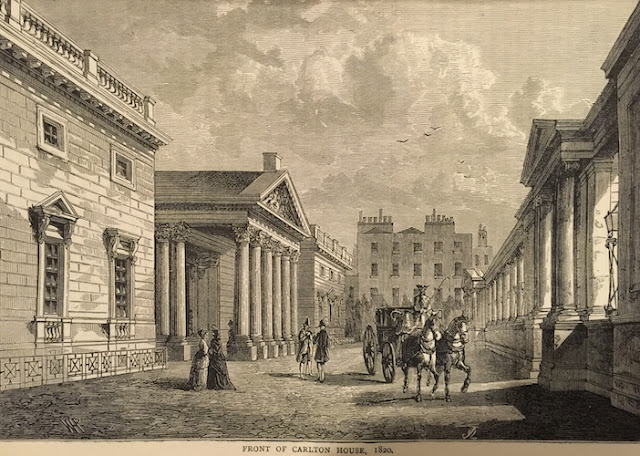
In London in 1817,  two years after the battle of Waterloo, a shocking event took place. A foreign gentleman who had arrived in the country three months earlier, shot himself in the head at the entrance to Carlton House in Pall Mall, the residence of the Prince Regent.       The melancholy background story tells us a lot about the unequal recognition and reward that was offered to the commanders in this allied victory in which British, Prussian, Hanoverian, Bavarian, Belgian, Piedmontese, Sardinians and even some Frenchmen fought side by side against the Imperial forces. The facts were reported in The Gentleman's Magazine a couple of weeks after his death, when a jury at the inquest pronounced a verdict of suicide caused by insanity, and having read various testimonies from his military colleagues, said that von Aacken had played a vital, key role in winning the battle of Waterloo. Without him the allied army would never have regained its position after the...

The Hon. Henry Berkeley Craven, a Regency Corinthian

Image
Hon Henry Berkeley Craven, miniature on ivory by George Sanders. Henry Augustus Berkeley Craven was Elizabeth Craven's sixth child, and second son. Born in December 1776, he was always known as Berkeley, a name chosen in honour of his mother's family.  He is to be seen aged three in this Berkeley-Granard group portrait at Berkeley Castle, where he is the merry little boy being carried on his mother's back. This image of him as a fun-loving imp matches everything we know about him throughout most of his life. A high-spirited, pleasure-loving sportsman and tearaway, he was daring, and perhaps a little inclined to show off.      Berkeley was sent to Eton and grew up to be tall and extremely handsome, the m ost robust of his brothers. He was fifteen when his father died. When he left school, his mother wanted to send him to university but her brother Frederick, who had been appointed one of his guardians by Lord Craven, refused. [1] So i n 1794, aged only 17, young Berk...

Sophie de Tott and Elizabeth Craven

Image
Sophie de Tott by Vigée-Lebrun Of all the emigrés who were welcomed to Brandenburgh House by Elizabeth Craven in the aftermath of the French Revolution, none was more remarkable than Sophie de Tott. She was an artist who exhibited her paintings at the British Royal Academy and when she came to stay at Brandenburgh House she painted portraits of Elizabeth's second husband the Margrave of Anspach and her son Keppel. Madame de Tott had once lived in Paris among the highest French aristocracy. As a girl she had been adopted by a rich Countess and lived in the heart of the capital, meeting all the leading intellectuals and enjoying the most cultivated salons. Laudatory poems had been written about her. She had known Louis XVI, Marie Antoinette, Lafayette, Madame de Stael and Elisabeth Vigée-Lebrun who painted this oval portrait of her in 1786. Since fleeing from Paris in the Revolution of 1789 she had lived in Switzerland and Germany, earning a living with her paintbrush. When...

Elizabeth Craven as a Patron: The Theatric Tourist

Image
Newbury Theatre from the Theatric Tourist 1804 Under the Patronage of Her Serene Highness the Margravine of Anspach, by Whose Permission an Engraving of Her Elegant Theatre Will be Given as a Frontispiece to the Publication, this Day (December 1, 1804) is Published, No. 4, of a Work Never Before Presented to the Public, Entitled The Theatric Tourist being a genuine collection of correct views, with brief and authentic historical accounts of all the principal provincial theatres in the United Kingdom / by a theatric amateur. London : T. Woodfall, 1805....printed for Sylvester, Clement Chapple, Edward Kerby, William Lindsell, Henry Delahoy Symonds, Thomas Woodfall, Vernon and Hood. The Theatre at Richmond in Yorkshire. J ames Winston (1773 or 79-1843) was an English actor, artist and sometimes architect who started as a strolling player and became manager of the Drury Lane Theatre in London by 1819. He is thought to have written one play "Perseverance" (1802) and he co...