Posts

The Craven Cookery Book

Image
  Elizabeth née Skipwith, wife of 2nd Baron Craven. Painted by Godfrey Kneller.       This attractive portrait of a lady from the reign of Queen Anne shows Elizabeth, wife of the 2nd Baron Craven, whose claim to fame is that she wrote a cookery book that survives in manuscript and is preserved in the library of Pennsylvania State U niversity in  America .     Elizabeth née Skipwith was born in 1677 or 1679. Her family lived at Newbold Hall in Warwickshire, not far from Coombe Abbey. She married the 2nd Baron Craven  on the 12th October 1697 and gave birth to two sons.    She belonged to a generation of women who were proud to preserve traditions of household management and herbal medicine from past centuries. Being a fine lady did not mean never going into the kitchen. She also liked to experiment with new ingredients such as chocolate. Her book of recipes, meticulously written, carefully attributes each recipe to the friend or relative ...

A poem by Anne-Marie Fauques de Vaucluse

Image
  STANCES. Je sommeille, & je touche au déclin de ma vie, Sans avoir réfléchi sur l'emploi de mes ans. Ah! Sortons à la fin de cette léthargie! Par de nobles travaux fixons l'aîle du tems. Laissons ces fleurs qu'en vain le zéphyre ca resse, & que l'air du midi fait à l'instant flétrir, Pourvoyons-nous plutôt des fruits de la sagesse, Le bonheur est promis à qui sait s'en nourrir. Si la nature avare a borné nos années, Suivons pour en user l'avis de la raison; Songeons qu'au bien public elles sont destinées, & qu'elles doivent rendre immortel notre nom. This short poem of only twelve lines is found in Nouvelles Fables, Fauques' collection of poetry published in 1772. It is introspective, and self-critical, as she chides herself for having achieved too little and resolves to endeavour to write something of lasting merit. How could these lines be translated into English? I  slumber, and I find my years fast vanishing Without du...

Elizabeth Craven, Aphra Behn and the scandal of Lady Harriet Berkeley

Image
   The Berkeley family was always notorious for scandal and wild escapades. Elizabeth Craven's elder sister eloped when very young, and one of her aunts had done the same.    The most scandalous episode in the family history took place in 1682 during the Restoration period, when Lady Henrietta Berkeley, daughter of the first Earl of Berkeley, ran away with her sister's husband, Lord Grey. He was prosecuted for abduction by Lord Berkeley, despite the fact that Henrietta had consented to the flight. Lady Henrietta (Harriett) Berkeley From an original picture by Sir Godfrey Kneller, at Strawberry Hill.    This scandal left its mark on the literature of the period, as Aphra Behn borrowed elements of the story for her sensational novel,  Love Letters from a Nobleman to his Sister.    Ford, Lord Grey of Warke, w as a bold, irrepressible rake, mixed up in more than one risky enterprise. He took a leading part in the Monmouth Rebellion, and wherever...

Coombe Abbey Nonpareil Apple

Image
    In past centuries, England had hundreds of different varieties of apple, all with slightly different shapes, colour and flavour. One of these was actually named after Coombe Abbey, the Craven ancestral home in Warwickshire, where it was first identified and grown.     Its name, the Coombe Abbey Nonpareil, means "incomparable" or "unrivalled". It was described in a book called The Botanic Garden; representations of hardy ornamental flowering plants cultivated in Great Britain; with their names, classes [&c.]. [With] The floral register [and] The fruitist, Volumes 10-11  Benjamin Maund 1824 .     We are told that this apple is not only delicious but will, in the right conditions, keep until March of the following year.    Credit for developing this variety from the earlier "Nonpareil" is given in the book to John Oliver, a gardener who was said in 1824 to have been working at Coombe Abbey for upwards of forty years. So he could be the g...

A portrait of 6th Baron Craven

Image
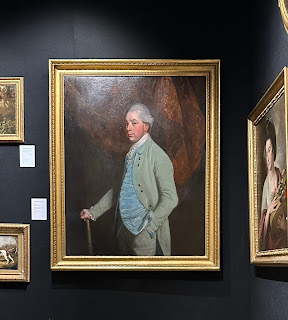
  This portrait of William, 6th Baron Craven, is currently on show in Berkeley Square London, among other Georgian paintings being sold by Isherwood Fine Art. It is very similar but not identical to the better-known portrait of him by Thomas Beach, in which he is holding the plans for Benham. Apparently three versions were painted, the third one with his right hand resting on a large dog.  It shows that Lord Craven could be quite a dandy, in this pale almond green velvet suit, with a quilted blue waistcoat and lace cravat. It would be a wonderful acquisition for one of the Berkshire museums or perhaps for the up-market restaurant that is going to be opened at 16, Charles Street, London, formerly the Craven home.

Sydney Morgan and the Craven Connection

Image
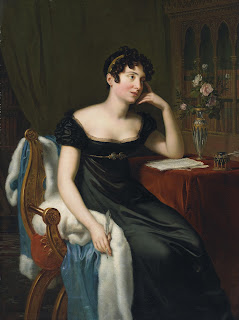
            Sydney, Lady Morgan, is a Regency period novelist whose name makes her sound far grander than she was. She was born Sydney Owenson, daughter of an actor in Dublin, and started writing novels about Ireland that were an immediate success. Her best known is entitled The Wild Irish Girl.      Her books were met with enthusiasm by many readers as well as damning reviews from some critics. She became a paid companion to Lady Abercorn, who persuaded her to marry Thomas Charles Morgan, the Abercorn   family physician;  he later got knighted as a result of the Abercorns pulling strings. So Sydney became Lady Morgan and as such was received in London high society. She went on to write many more novels and books about France and Italy where she travelled widely. Her very Liberal and allegedly republican views got her banned from Tuscany by the Austrian rulers, but only after she had visited it and described it in detail. ...

Rape in Regency London

Image
Fitzroy Square London c.1800     We've recently been told that less than 5 per cent of rapes reported in England today lead to prosecution. I n Regency England, it was very different. A man accused of rape could face such severe penalties as the reproach of his wife -- a fearsome deterrent! East Fitzroy Square, London 1807 This case was reported in 1817 as taking place in Fitzroy Square in the heart of Mayfair. The accuser, or "prosecutrix" as she was called in court, was a fourteen-year-old servant girl and the man she accused was her employer, a butcher in Fitzroy Market.      The newspaper report ran:- WEDNESDAY. - Clark, a butcher, in Fitzroy-market, was indicted for a rape on  Leah   Edwards . The prosecutrix deposed, that she is 14 years of age. Her mother resides in Grafton-street, Fitzroy-square, and she herself was servant to the prisoner, who is a married man.      On the night of the 13th of March, the prisoner was from h...