Posts

The Cravens by Clive Williams - book review

Image
       Clive Williams, author of a previous book about the history of Berkshire, The Nabobs of Berkshire , has now written The Cravens , a history of the entire Craven family. He traces it from its first rise to wealth in the Tudor period, to its glory days under the Stuarts and Hanoverians, when Craven earls and barons were among the greatest landowners in Berkshire and among the richest peers in Britain, through to the decline of their fortunes in the twentieth century.  The Cravens' London house 16, Charles Street, Mayfair    Williams  has put a lot of research into this book, which has many illustrations, and draws on many documents. He tracks down the sources of the wealth that made William, the first Earl Craven under King Charles I, such a powerful player in the wars of the time and in politics at home and abroad. It seems that the financial acumen of his mother was a major factor. Craven volunteered at the age of sixteen to go to the ...

Henrietta Colebrooke, translator of Rousseau

Image
     In 1781, an anonymous translation of Diderot’s stage-play Le Père de Famille appeared in England. It is entitled "The Family Picture" and the translator is named on the title page as simply "A Lady". The list of subscribers included a lot of people of high rank, many of whom lived in Wiltshire or the Isle of Wight. It also included a lot of minor members of the Craven family. These include a "Mrs Craven", possibly Mrs Mary Craven, the mother of Lord Craven, "Mrs Liddiard of Bath" - the married name of Jane, sister of Lord Craven - and "Mr William Hicks and Mr John Hicks of Gloucester", cousins of Mrs Craven, whose maiden name was Hicks.      These two clues lead me to wonder whether the Diderot play was translated by Miss Henrietta Colebrooke who is named in 1788 on the title page of  Thoughts of Jean-Jacques Rousseau: Selected from His Writings... and Translated by Miss Henrietta Colebrooke (2 volumes, London, 1788). The introduc...

Cornelia, the American Countess of Craven

Image
  Like many other great English families, in the late nineteenth century the Cravens were strapped for cash. Running numerous stately homes and mixing in London society had become ruinously expensive, particularly after the ambitious building projects of the third Earl. So the fourth Earl decided to follow the trend and in 1893 he married an American heiress, which was the obvious solution. Cornelia Martin, 1877-1961.     The Martins, an  immensely wealthy family of New York bankers, bought an an estate in Scotland where in the early 1890s they met William George Robert Craven, the fourth Earl, and introduced him to their daughter Cornelia. With no discouragement from her parents, he  proposed to Cornelia and married her in 1893 when he was twenty-four, and she was only sixteen.       Cornelia entered London society, where other American heiresses such as Lady Randolph Churchill and the Duchess of Marlborough, took a leading rôle. With he...

A Letter from Elizabeth Craven to Dr Edward Jenner

Image
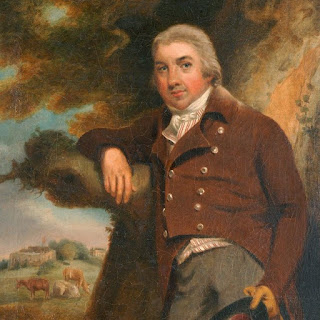
     There is a letter from "E. Craven" dated 21st April 1791 in the collection of the Wellcome Foundation in London. The library catalogue does not identify it as being from Elizabeth Craven, let alone cross-reference it. Nor does it connect it in any way with Dr. Edward Jenner, the celebrated physician. It is in the papers of the Reverend George Charles Jenner (1767-1846), who was in 1791 the vicar of Berkeley in Gloucestershire, a parish that included Craven's ancestral family home, Berkeley Castle.       T he Berkeleys and Cravens had very close links with the Jenner family, who held this church living for many generations. The Earls of Berkeley were patrons of the parish and chose its incumbent. The Rev. George Jenner was the son of the Rev. Henry Jenner (1737-1798) previous vicar of Berkeley, who had succeeded his father the Rev. Stephen Jenner (1702-1754).      Dr Edward Jenner (1749-1823), the pioneer of vaccination, wa...

Who Betrays Elizabeth Bennet? In defence of Charlotte Collins.

Image
     In his book  Who Betrays Elizabeth Bennet?: Further Puzzles in Classic Fiction , Professor John Sutherland raised the question of how the rumour of Elizabeth Bennet's imminent engagement to Mr Darcy could have reached the ears of Lady Catherine de Bourgh, prompting her to make her bossy and interfering call on Elizabeth at Longbourn in volume 3 of Jane Austen's Pride and Prejudice .      I love this sort of criticism, which used to be referred to as the "How many children had Lady Macbeth?" school. Now desperately unfashionable, it treats characters in novels as real people who exist beyond the parameters of the written narrative and can thus be followed and investigated outside the boundaries of the text. It makes an interesting game, and it is certainly far less absurd than many of the currently fashionable schools of criticism. Professor Sutherland is right, that if we cannot provide any reasonable explanation of how and why this rumour travell...

The Children of Apollo - Fame and Infamy in Georgian England

Image
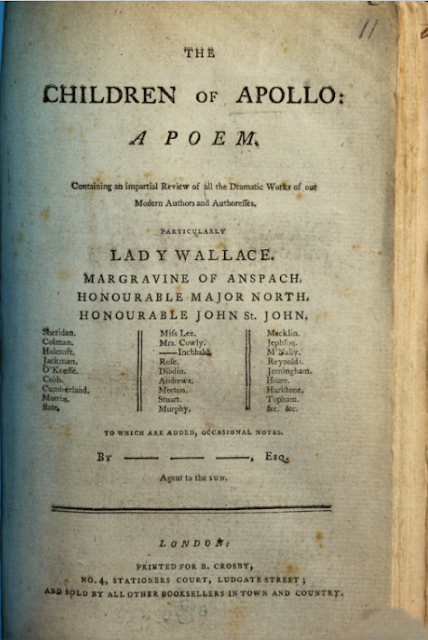
       Throughout her life, Elizabeth Craven was haunted by the scandal deliberately spread by her first husband, Lord Craven, at the time of their separation. It was impossible for any woman to separate from her husband in Georgian England without a tinge of unpleasant scandal, and he went further than most irate husbands, spreading sensational accounts of her behaviour to stir up malicious gossip.      Needless to say, he did not attract any opprobrium for having a mistress, but she f or the rest of her life, struggled to throw off this unfair reputation.     In 1794, when she had re-married and returned to England, a lengthy poem appeared entitled  The Children of Apollo: a Poem. Containing an Impartial Review of all the Dramatic Works of out Modern Authors and Authoresses. Particularly Lady Wallace. Margravine of Anspach. Honourable Major North. Honourable John St. John. Sheridan. Colman. Holcroft. Jackman. O'Keeffe. Coob. Cumberland...

Park Street, London, home of Sophie de Tott

Image
When Sophie de Tott came to England in 1802, she and other French refugees got favourable treatment since Great Britain was at war with Napoleonic France. The public was sympathetic, and there were subscriptions raised in their favour. She got commissions as a portrait painter and gave musical evenings. While she was not well off, by 1809 she was able to afford lodgings in Park Street, a pleasant part of Mayfair close to Park Lane. One of her letters to Elizabeth Craven is dated from Park Street. The house Sophie lived in has been modernised, but this nearby house a few doors away is preserved in the original Georgian style. Built in the 1720s it had five stories, including a basement where the kitchen was situated.  It would be wonderful to have a blue plaque attached to one of the houses in this street, to commemorate the fact that Sophie de Tott lived here. Painter, novelist, musician and secret agent, she surely merits it and should be celebrated. https://www.lulu.com/shop/juli...