Posts

Kingston Bagpuize House

Image
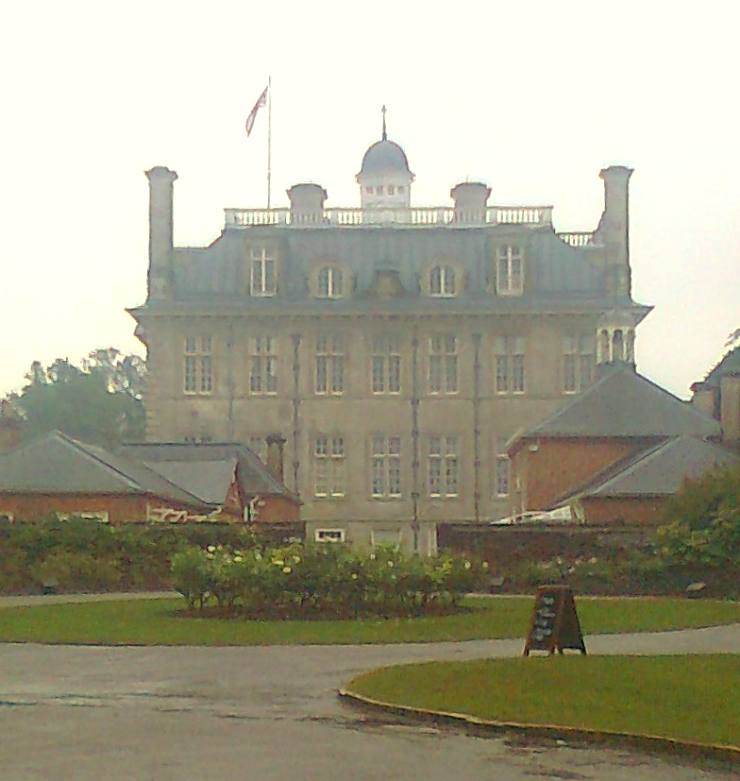
  Kingston Bagpuize House in Oxfordshire is very close to Benham Place and Ashdown House, and was originally built in 1660, at the same time as Ashdown House. It was updated in the 1720s to give it fashionable neo-classical trimmings, including a pedestal on the front, and wings, but it still has much of the  character of a Restoration mansion, with its red brick and very tall windows. This photograph of what is now the rear of the house shows the original front. The interior has been very sympathetically furnished by the present owners, and contains a fine collection of Chinese porcelain, making it into a good example of the style of a Georgian house of the period of Elizabeth Craven.   There is an impressive oak cantilevered staircase in the front hall. The portrait above the doorway is of Sir Walter Raleigh. The height of the ground floor windows means that the reception rooms are well lit. A family portrait from the 1790s hangs in the dining-room. The dining-room is l...

Newsletter of Elizabeth Craven Society February 2021

Image
TRANSLATIONS OF CRAVEN'S WORKS Craven's travel writings continue to be the part of her output that gets the most attention. A French scholar, Hélène Palma, has translated her Voyage to Constantinople into French and written an introduction and notes, which it well deserves. Voyage à Constantinople en passant par la Crimée: série de lettres de l'honorable Lady Elizabeth Craven à son altesse sérénissime le Margrave de Brandenbourg, Anspach et Bayreuth, écrit en l'an 1786 / édition critique et commentaires Hélène Palma.  Aix-en-Provence: Presses Universitaires de Provence, 2018. And Craven has been mentioned in this book,  Heritage Tourism Beyond Borders and Civilizations: Proceedings of the Tourism Outlook Conference 2018.  Springer Nature, 2020 While it is not entirely accurate to the last detail, it provides the interesting information that Elizabeth Craven 's letters about Turkey were translated into Turkish in 1939 by   E ş at Ekrem Co ç u. CRITICAL ATTENTION Cra...

Émilie du Châtelet, A Shared Anniversary

Image
December 17th is the birthday of Elizabeth Craven who was born in London in 1750. It also happens to be the birthday of another remarkable eighteenth-century woman, Émilie du Châtelet, who was, in her way, just as daring, unconventional and ground-breaking. She was the first to translate Newton's Principia into French, a quite staggering achievement because the translator had to understand the science thoroughly as well as have a perfect command of both Latin and French. Gabrielle-Émilie de Bréteuil was born on 17th December 1706, daughter of the Baron  de Breteuil  who had a court post at Versailles, and like Craven she had an outstanding education. She was taught Latin and mathematics, and went on to study English and Italian. As she grew up she developed a keen interest in physics, but could not of course study at any university, and in 1725 at the age of nineteen she was married to the Marquis du Châtelet.  After she had given birth to three children including two bo...

The Owners of Brandenburgh House: Prince Rupert

Image
Prince Rupert (1619-1682),1st Duke of Cumberland and Count Palatine of the Rhine by Gerard van Honthorst (1592-1656) in  1642. Of all the owners of Brandenburgh House in its two hundred year history, Prince Rupert of the Rhine is the most illustrious. He is famous for his military heroism on the Royalist side in the Civil War, but as well as being an outstanding cavalry leader he was also a sea captain, at one time a pirate, a scientist, an inventor, an artist, a sportsman and a business entrepreneur who set up the Hudson Bay Company and became its first governor. Rupert was distantly related to Elizabeth Craven, who was descended from the prince's cousin Charles II through the Richmond line. And he was a lifelong friend of the Earl of Craven, who was devoted to Rupert's mother and built Ashdown House for her. Portrait by Lely said to be  Margaret Hughes. Once in collection of  1st Earl of Craven. In the Restoration period, Prince Rupert bought the  pro...

Kingston Lacy House, Dorset

Image
Kingston Lacy House, in Dorset, the ancestral home of the Bankes family, is a National Trust property I went to see last week in order to get what NT director Tony Berry calls "the outdated mansion experience," or what others would call a chance to appreciate fine architecture and works of art in their original setting and context.  Like Coombe Abbey, it has facades in different styles, as one side of the original Restoration building was given a more Palladian look in the following century. Both are strikingly handsome and the house contains a substantial art collection amassed by its owners over generations. The website tells us that this is a "Venetian palace in the Dorset countryside" but to my mind, the house with its Italianate architecture, statues and paintings, has rather more resemblance to a baroque building in Rome or Naples in its scale, its atmosphere and grandeur. It could be the palace of a cardinal. I would not have been surprised to learn that that...

Can We Trust the National Trust?

Image
Anyone interested in our history and heritage must be alarmed at the recent leak of an internal document suggesting that the National Trust may be contemplating a drastic change of policy.  Kingston Lacy House, a National Trust Property in Dorset .    The Times reports that the NT is set to sack a whole top tier of art specialists, hold fewer exhibitions and keep only twenty of its five hundred historic houses continually open to the public. They are also planning to sack their education officers and discontinue affordable visits to their properties for schoolchildren.  If that is true it sounds like a complete betrayal of the mission of the NT. Families gave or sold their properties to the NT on the understanding that they would be available for enjoyment by the whole public, in perpetuity. A paper written by NT director Tony Berry, full of slick jargon that makes one shudder, proposes an “urgent review" of opening hours and the development of “new sources of exper...

Chawton House, the home of Jane Austen's brother

Image
Jane Austen's brother Edward owned the large estate of Chawton in Hampshire including this Tudor manor house which Jane called the Great House. He was fortunate enough to have been adopted by its previous owners, the Knight family. Something rather similar happens to Frank Churchill in Emma . The Knights were  distant relatives of the Austens, and had no child or heir of their own. They could have adopted any one of the Austen children, but they were only interested in a boy. It was an early lesson for Jane about how girls were less valued. When he grew up, Edward rarely lived at Chawton House as he acquired an even grander mansion, Godmersham Park in Kent, which became his by marriage.  When he was at Chawton, and his mother and sisters were installed in the cottage, they were frequently invited to visit him at the Great House. It was only a short walk from their home along a country lane and then up the drive.  Tall trees create a splendid avenue (just like the one at S...